Blog Topic: “Personality Inventory 7” – Pieter Schoolwerth’s
Student Name: Chan Pak San
Student number: 57155254
Introduction
The artist Pieter Schoolwerth works primarily with a hybrid method of painting which combines computer generated imagery with traditional methods of using oil and acrylic techniques. I am particularly interested in his work especially for “Personality Inventory 7” that explores the fragmentation of identity in our current digital age and the tension between physical and virtual realities which shows the way technology mediates our perception of human form. I think how he created this painting of layers of digital creation and the physical intervention provides a strong sense on the construction of the self in the post-internet world.
For the research this week, I focused on the painting which appears to be from his 2019 series of works “Personality Inventory”. It serves a perfect illustration of many core concepts of new media art with compositing and glitch to the philosophical questions of a simulated reality.
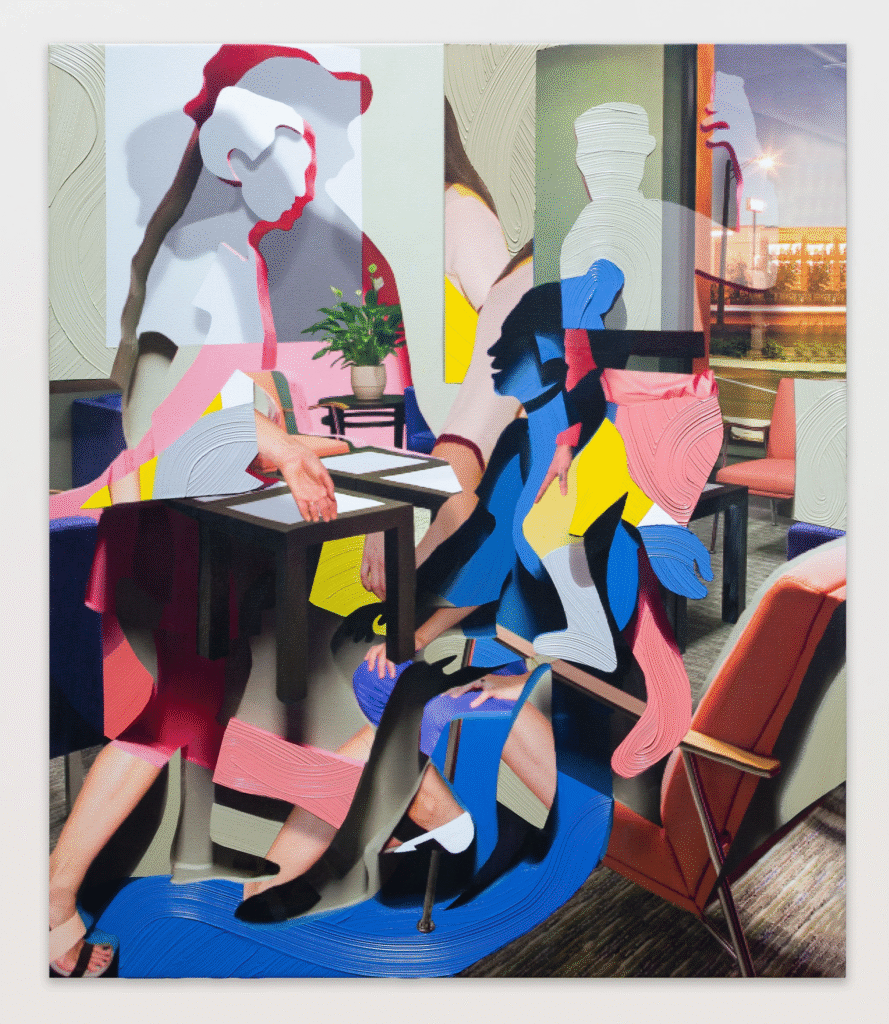
(Img source: https://www.k-t-z.com/artworks/772-pieter-schoolwerth-personality-inventory-7-2019/)
Painting & Analytics
From what I observed in the painting, it is built from distinct, non-integrated layers. The base layer is a photorealistic space of a lobby-like interior, which functions as the “signal” or the baseline reality. On top of the layer, there are many fragmented figures being composited in which some are blank silhouettes and some are assembled from the photorealistic limbs and abstract blocks of colors, creating a sense of “glitched” or corrupted digital file. For me this element relates to the concept of Potemkin Village, as the figures appear as hollow facades or like curated collections of parts hiding the lack of coherent and unified self behind them.
I think the most significant feature is the thick final layer of gestural paint that traces and sometimes covers the printed elements. Relating to the Calude Shannon’s idea of signal to noise ratio, the clean digital image is the signal and the chaotic, while physical paint strokes introduce a deliberate “noise.” I believe Schoolwerth intentionally created these distortions to allow the body surface to disconnect from its underlying structure. This is also relevant to the visualization of Manovich’s principle of transcoding, in which the meshes, rigs, and potential for error becomes the language used to represent the cultural logic of a fragmented digital self.
In regards to the question of how it reflects the quality of a digital image, I think the painting deconstructed the inherent qualities of a digital image itself. It is fundamentally flat, but with layers and surfaces composed of different blocks of colors. The contracts exposed the layered nature of digital creation just like most of the modern design softwares (illustrator/photoshop) where each element, the background, the figures, the vectors all exists on a seperated while editable layer making this digital architecture visible and tangible. Meanwhile, the compression and loss can be comprehended by the fragmented, hollow and distorted figures which could be a metaphor for data that is discarded during the digital translation of reality itself. And the most obvious is the malleability and glitches. A digital image is infinitely malleable in which the code can be warped, stretched and broken. He used the method of “breaking the rig” as a way to show exploitation of this quality, in which the surface can slide off the skeleton and the resulting glitches are not errors to be fixed but as evidence of the digital image’s inherent fragility and artificiality.
Conclusion
With the latest technology like generative AI recreating images and remixes, I believe there are more space to explore beyond traditional layering and deliberate glitching. In reference to Manovich’s variability and modularity, where each generated image is a unique version shaped by algorithmic processes or you can say a neural network. There could be more approaches on the tension between human intentionality and algorithmic creativity.
Leave a Reply