Blog Topic: “Domestic Tension” by Wafaa Bilal
Student Name: Chan Pak San
Student number: 57155254
Introduction
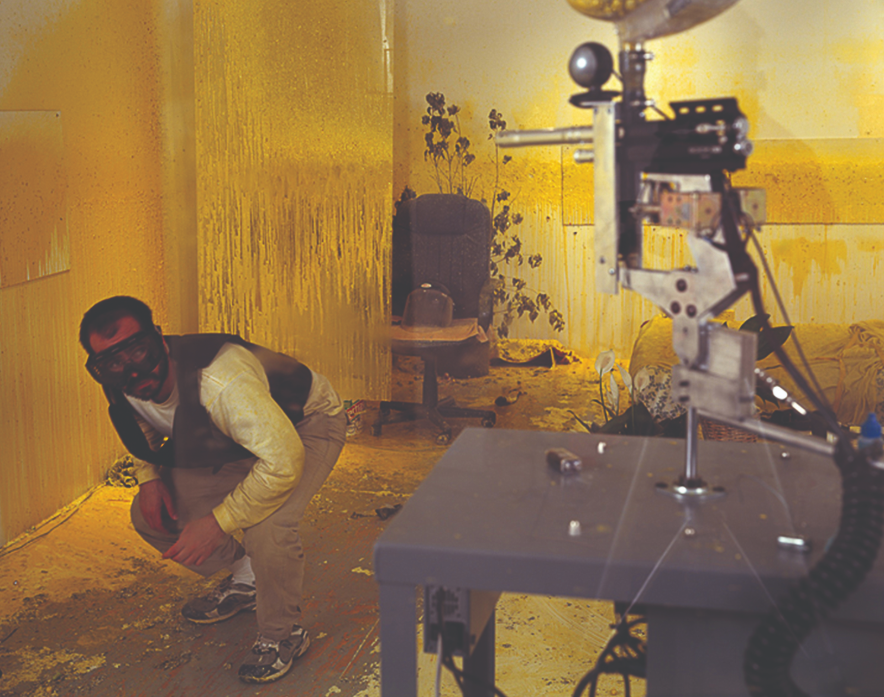
The performance of Wafaa Bilal’s 2007 “Domestic Tension” is quite a unsettling work of the interactive new media art for me. Waffa Bilal has created this one-month long performance that confined himself in a gallery in Chicago. In the gallery, he designed this making himself as the target of a remote controlled paintball gun. This gun could be fired by anyone online 24/7 and which demonstrated the weaponization in the very technology of telepresence. Given that the webcam, remote control and the networked communication is not used for as its original intention of fostering connection between others but have been used for a direct and visceral confrontation, this work actually explored a violent potential of the mediated touch and serving as a powerful critique of the disembodied nature of modern warfare, also relevant to the core theme of the lecture of how technology’s role is distancing us from the consequences of our own actions.
(Img source: https://anthology.rhizome.org/domestic-tension)
Artwork & Analytics
In this interactive performance, this gallery room which Wafaa Bilal was in have became a physical-virtual “battleground”. Online users from anywhere in the world could watch his performance with the live cam, and which they can also chat with him or even fire the paintball gun at him. This is showing the act of mediated violence centraling to the work, in which Wafaa Bilal was trying to let people who are living in the “comfort zone” knowing the realities of the “conflict zone” in Iraq, where his brother was killed by a remote US drone strike. This intention served as a mirror to a gamified-like interface of remote warfare, making it as if it was some kinds of video game.
This work presense the idea of telepresence, which is defined as the feeling of being present at a remote location by the means of real-time telecommunications devices. The online users with the computers are shown to an interface that creates a sense of agency and presence in the gallery, and their actions, click have given the immediate real-time effect to the gallery, to Wafaa Bilal and the artwork itself. I think the anonymous online shooter in this artwork “Domestic Tension” are the perfect embodiment of the fantasy that Katherine Halyes suggested. The actions from the users are disembodied, and detached from the physical pain or psychological trauma they inflict. And the artwork itself received 60,000 shots over 30 days, which made Bilal to have experienced some symptoms of PTSD.
Given that the online shooters remain comfortably disembodied, Bilal standed in the opposite direction of this embodiment – hyper-embodied. He himself put his own physical presence and potentially the mental well-being to create a strong sense of the consequences of the mediated “touch” visible and real which can be seen by his bruised body and the paint splattered across the room, showing the “physical trace” of the digital actions. This ultimately created a sense of causal link between a disembodied action and its embodied consequence to the audience which also raised ethical and political crises.
Conclusion
This artwork have strongly shows how the lecture mentioned about the mechanics of telepresence and showing a profound moral challenge in today’s world, revealing how technologies originally designed to make the world better but also facilitate violence by creating psychological distance and a false sense of consequence-free actions. This work powerfully aligns with Hayles’s call to resist disembodiment by reminding everyone of us that behind every “operational image” or any remote action, they could be a physical and a vulnerable body in reality. This remains a very strong work that presented the ethical dilemmas that forces us to confront the human cost of our mediated actions.
Leave a Reply